Leading with clarity, courage, adaptability, and humanity
Article Information
| Category | Talent & Leadership Insights |
| Publication Date | 16th August 2026 |
| Author | Dr Rosemary Muriungi @Kipawa-TLD |
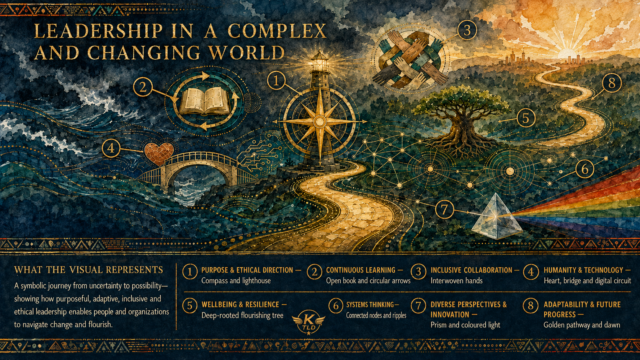
About the Featured Image
Guiding Through Complexity Toward Flourishing
The image reflects a symbolic journey from uncertainty to possibility—showing how purposeful, adaptive, inclusive, and ethical leadership enables people and organizations to navigate change and flourish.
Symbolism in the Image
- Compass and lighthouse — purposeful, ethical, and courageous leadership.
- Golden pathway — navigating uncertainty toward opportunity and flourishing.
- Open book with circular arrows — learning, unlearning, and relearning.
- Heart–technology bridge — balancing innovation with humanity.
- Interwoven hands — inclusion, diversity, and collaboration.
- Deep-rooted tree — resilience, wellbeing, and sustainable performance.
- Connected nodes — systems thinking and collective intelligence.
- Prism — diverse perspectives, creativity, and innovation.
- Storm-to-dawn transition — moving through disruption toward a hopeful future.
Leadership in a Complex and Changing World
Leading with clarity, courage, adaptability, and humanity
The world in which leaders operate is becoming more interconnected, uncertain, and fast-moving. In this environment, effective leadership is no longer defined simply by authority, expertise, or control. It is reflected in the ability to navigate complexity, mobilize people around a shared purpose, make responsible decisions, and enable individuals and organizations to adapt, flourish, and create meaningful impact.
Change has always been part of organizational life. What distinguishes the present era is its speed, scale, and interconnectedness. Technological advancement, artificial intelligence, shifting workforce expectations, economic uncertainty, geopolitical tensions, climate-related disruption, demographic change, and evolving social values are reshaping how people live, work, learn, and lead.
A decision made in one part of an organization—or one part of the world—can quickly generate consequences elsewhere. Leaders must therefore respond not only to individual challenges but also to the relationships, tensions, and interdependencies among them.
In such a world, there may be no straightforward answer, complete information, or tested solution. Leadership must evolve accordingly.
From Managing Certainty to Navigating Complexity
Traditional approaches to leadership were often developed for relatively stable environments. Leaders were expected to establish direction, allocate resources, maintain control, solve problems, and ensure that plans were implemented efficiently. These responsibilities remain important. However, they are no longer sufficient.
Complex challenges rarely follow a predictable sequence of cause and effect. They often involve multiple stakeholders, competing priorities, changing circumstances, and consequences that cannot be fully anticipated. A technically sound solution may fail if it overlooks organizational culture, human behaviour, stakeholder interests, or the wider operating environment.
Leadership in complexity therefore requires more than providing immediate answers. It requires leaders to:
- Interpret emerging patterns and changing conditions.
- Distinguish complicated problems from genuinely complex challenges.
- Ask thoughtful questions before settling on solutions.
- Bring together different perspectives and sources of knowledge.
- Test assumptions and learn from experience.
- Make timely decisions despite incomplete information.
- Adjust direction as new evidence and possibilities emerge.
This is not indecision. It is disciplined adaptability—the ability to move forward with purpose while remaining open to learning and change.
Purpose as an Anchor
When circumstances are uncertain, purpose provides stability without creating rigidity. It helps people understand why their work matters, what the organization stands for, and how decisions should be evaluated.
A clear purpose does not eliminate uncertainty. It provides a compass for navigating it.
Purpose-driven leaders connect strategy with meaning. They help people see how their roles contribute to broader organizational and societal outcomes. They also ensure that short-term pressures do not displace long-term responsibility.
This requires leaders to translate purpose into everyday choices: how resources are allocated, how people are treated, which opportunities are pursued, what conduct is rewarded, and which compromises the organization is unwilling to make.
Purpose becomes credible when it is experienced—not merely stated.
Adaptive Leadership and Continuous Learning
In a changing world, leadership effectiveness depends increasingly on the capacity to learn, unlearn, and relearn.
Leaders must remain curious enough to question familiar practices, humble enough to recognize the limits of their knowledge, and courageous enough to revise decisions when circumstances change. Experience remains valuable, but it must not become an obstacle to fresh thinking.
Adaptive leaders create environments in which experimentation, reflection, and responsible innovation are encouraged. They treat setbacks as sources of insight while maintaining appropriate standards of accountability. Rather than concealing uncertainty, they help people engage with it constructively.
This learning orientation extends beyond individual leaders. Organizations must build collective capabilities for sensing change, sharing knowledge, challenging assumptions, and translating insight into action.
The organizations most likely to remain relevant will not necessarily be those that already know the most. They will be those that can learn and adapt most effectively.
Leading People Through Change
Every organizational transformation is also a human transition.
A new strategy, technology, structure, or operating model may appear logical on paper, yet it can still generate uncertainty, loss, resistance, and anxiety among the people expected to implement it. Leaders who focus only on systems and outcomes may underestimate the emotional and psychological dimensions of change.
People want to understand what is changing, why it is necessary, how it will affect them, and whether their contribution will continue to matter. They also need opportunities to participate, develop new capabilities, and regain a sense of confidence and direction.
Effective leaders therefore combine strategic clarity with empathy. They communicate honestly, listen attentively, acknowledge legitimate concerns, and create meaningful opportunities for participation. They do not promise certainty where none exists, but they provide as much clarity as possible about purpose, priorities, decisions, and next steps.
Trust is strengthened when leaders are visible, consistent, and truthful—especially when the message is difficult.
Inclusion as a Leadership Capability
Complex challenges cannot be understood adequately through a single perspective. Inclusive leadership is therefore not only a matter of fairness; it is an essential capability for sound judgment, innovation, and organizational resilience.
Today’s organizations bring together people from different generations, professions, cultures, identities, geographic locations, and lived experiences. This diversity can enrich decision-making, but only when people can contribute meaningfully and when power does not silence less dominant voices.
Inclusive leaders intentionally broaden participation. They ask whose knowledge is present, whose experience may be missing, who will be affected by a decision, and whether people feel sufficiently safe to raise concerns or challenge prevailing views.
Inclusion does not mean that every preference can determine the final decision. It means that relevant voices are heard, differing perspectives are considered seriously, and decisions are made through processes that are respectful, transparent, and responsible.
Technology Balanced with Humanity and Ethics
Digital technologies and artificial intelligence are transforming how organizations operate, communicate, learn, and make decisions. They can improve access, efficiency, personalization, and innovation. They can also amplify bias, widen inequalities, compromise privacy, and distance decisions from their human consequences.
Leaders must therefore look beyond the question, “What can this technology do?” They must also ask:
- What problem are we trying to solve?
- Who will benefit, and who may be disadvantaged?
- What human judgment must be retained?
- How will data, privacy, and security be protected?
- What skills will people need?
- What ethical principles should guide adoption?
- How will unintended consequences be identified and addressed?
Responsible digital leadership is not anti-technology. It seeks to ensure that technology expands human capability and contributes to sustainable value without undermining dignity, fairness, accountability, or trust.
Courage, Ethics, and Responsible Judgment
Complexity can create pressure to prioritize speed, performance, or institutional survival at the expense of values. Yet difficult environments make ethical leadership more—not less—important.
Leaders frequently encounter competing obligations: achieving results while protecting wellbeing, embracing innovation while managing risk, responding quickly while ensuring inclusion, and meeting immediate demands while safeguarding long-term sustainability.
Ethical leadership is rarely about choosing between an obvious right and an obvious wrong. More often, it involves exercising judgment where legitimate values and responsibilities are in tension.
Responsible leaders make their reasoning visible. They consider the impact of decisions on different stakeholders, recognize potential conflicts of interest, invite appropriate challenge, and accept accountability for both intended outcomes and foreseeable consequences.
Courageous leadership may require confronting uncomfortable realities, questioning established practices, admitting mistakes, defending important principles, or making decisions whose benefits will only become evident over time.
Wellbeing and Sustainable Performance
Constant disruption can place significant pressure on leaders and their teams. Persistent urgency, digital overload, role ambiguity, and emotional strain can weaken judgment, creativity, relationships, and performance.
Wellbeing should not be treated as an optional benefit or an individual responsibility alone. It is influenced by leadership behaviour, workload, organizational culture, job design, psychological safety, and the quality of workplace relationships.
Leaders shape wellbeing through what they model and normalize. When exhaustion is celebrated as commitment, people may feel compelled to sacrifice their health to demonstrate value. When reflection, recovery, respectful challenge, and reasonable boundaries are supported, sustainable performance becomes more achievable.
Resilient leadership is not simply the ability to endure pressure. It also involves addressing avoidable sources of pressure, drawing on collective support, and building systems that help people remain capable and well over time.
Collaboration Across Boundaries
Many contemporary challenges extend beyond the authority or capability of any single leader, team, discipline, organization, or sector. Addressing them requires collaboration across traditional boundaries.
Collaborative leaders build relationships before crises demand them. They connect people around shared outcomes, create space for constructive disagreement, and distribute responsibility to those closest to the relevant knowledge or experience.
This requires a shift from seeing leadership as an individual performance to understanding it as a collective process. The leader’s role is not always to occupy the centre. At times, it is to convene, connect, facilitate, enable, or create the conditions in which others can lead.
Collaboration does not remove accountability. It makes accountability more deliberate by clarifying roles, decision rights, mutual expectations, and shared commitments.
Developing Leadership for the Future
Leadership development in a complex world cannot rely on transferring knowledge alone. Leaders need opportunities to apply ideas, examine assumptions, practise difficult conversations, work through realistic dilemmas, receive feedback, and reflect on the impact of their behaviour.
Effective leadership development should integrate:
- Strategic and systems thinking.
- Self-awareness and personal mastery.
- Adaptive decision-making.
- Ethical reasoning and responsible governance.
- Inclusive and cross-cultural leadership.
- Communication and influence.
- Digital and AI literacy.
- Change and transformation leadership.
- Coaching, collaboration, and talent development.
- Psychological wellbeing and resilience.
- Continuous learning and reflective practice.
Leadership development must also extend beyond people in formal positions of authority. Organizations become more adaptable when leadership capability is cultivated at multiple levels and people are empowered to exercise initiative, judgment, and responsibility within their roles.
A Continuing Leadership Journey
There is no final formula for leading in a complex and changing world. Contexts will continue to evolve, new challenges will emerge, and yesterday’s solutions may not meet tomorrow’s needs.
The enduring task of leadership is to remain grounded in purpose while responding intelligently to change; to combine courage with humility, performance with wellbeing, technology with humanity, and authority with inclusion.
The leaders who shape a better future will not be those who claim to possess every answer. They will be those who help people make sense of uncertainty, unlock collective capability, uphold ethical responsibility, and turn disruption into opportunities for learning, innovation, and flourishing.
Leadership in a changing world is ultimately not about predicting the future with certainty. It is about developing the clarity, character, relationships, and adaptive capacity needed to shape it responsibly.
How Kipawa-TLD Can Help
Kipawa-TLD works with individuals, businesses, organizations, institutions, and communities to strengthen the leadership capabilities required in an increasingly complex world. Through integrated consulting, capability development, coaching, and transformative learning experiences, we help leaders navigate change, mobilize talent, strengthen organizational capability, and create conditions in which people and institutions can flourish.
Kipawa-Talent & Leadership Development (Kipawa-TLD)
Elevating Potential. Expanding Horizons.
