Rethinking how we discover, develop, deploy, and sustain human potential
Article Information
| Category | Talent & Leadership Insights |
| Publication Date | 16th August 2026 |
| Author | Dr Rosemary Muriungi @Kipawa-TLD |
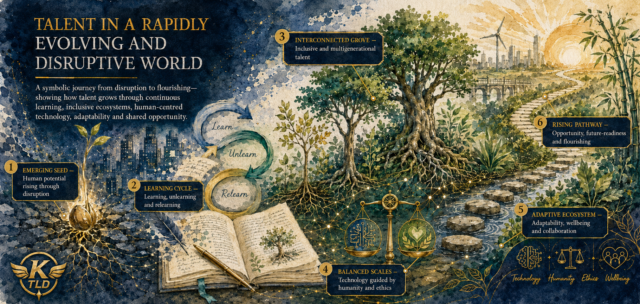
About the Featured Image
Talent’s Journey from Disruption to Human Flourishing
An interconnected symbolic landscape capturing:
- A seed emerging through fractured ground — human potential amid disruption.
- The open journal and circular arrows — learning, unlearning, and relearning.
- Saplings, mature trees, and interconnected roots — inclusive and multigenerational talent.
- The balanced Artificial Intelligence (AI) brain and living heart — technology guided by humanity and ethics.
- Bamboo, flowing water, connected stepping stones, and supportive vegetation — adaptability, wellbeing, and collaboration.
- The rising pathway, sustainable city, and golden horizon — opportunity and flourishing.
Talent in a Rapidly Evolving and Disruptive World
Rethinking How We Discover, Develop, Deploy, and Sustain Human Potential
The world of work is changing at an extraordinary pace. Technological advancement, artificial intelligence, demographic shifts, globalization, climate-related pressures, new business models, and changing workforce expectations are reshaping industries, organizations, occupations, and careers.
Some roles are disappearing, others are being redesigned, and entirely new forms of work are emerging. Skills that were valuable only a few years ago may no longer be sufficient, while capabilities such as adaptability, creativity, digital fluency, critical thinking, collaboration, and resilience are becoming increasingly important.
Within this environment, talent can no longer be understood simply as the qualifications, experience, or the technical expertise an individual already possesses. Talent must be viewed as dynamic human potential—the capacity to learn, adapt, contribute, innovate, and grow in response to changing circumstances.
For individuals and organizations alike, the central question is no longer merely, “What talent do we have?” It is also:
“What could this talent become, and how can it be prepared to thrive in an uncertain future?”
From Fixed Talent to Evolving Capability
Traditional approaches to talent management have often emphasized job descriptions, qualifications, performance ratings, succession charts, and the identification of a relatively small group of “high potential” employees. Although these practices remain useful, they are no longer sufficient on their own.
In a rapidly evolving world, talent cannot be treated as a fixed asset. It must be continuously discovered, nurtured, developed, repositioned, and renewed.
An employee who performs exceptionally well today may struggle if their role changes and they have not developed the capacity to adapt. Conversely, a person whose abilities have been overlooked may flourish when given meaningful exposure, encouragement, coaching, and an opportunity to work differently.
This requires organizations to move beyond narrow assessments of current performance and consider broader indicators of potential that include:
- Curiosity and willingness to learn;
- Adaptability in unfamiliar situations;
- Ability to solve complex problems;
- Creativity and openness to experimentation;
- Emotional intelligence and self-awareness;
- Collaboration across cultures, functions, and generations;
- Courage to question established assumptions;
- Resilience during uncertainty and transition; and
- Capacity to translate learning into meaningful action.
The future belongs not only to those who know the most, but also to those who can continue learning, unlearning, relearning, and applying knowledge in new contexts.
Disruption Is Redefining Valuable Talent
Disruption does not eliminate the importance of talent—it changes the kinds of talent that organizations need and how that talent creates value.
Artificial intelligence and automation are increasingly performing routine, repetitive, and data-intensive tasks. However, this does not make human contribution irrelevant. Instead, it increases the value of capabilities that technology cannot easily replicate.
These include judgment, empathy, ethical reasoning, imagination, relationship-building, contextual understanding, cultural intelligence, and the ability to inspire confidence and collective action.
Tomorrow’s talent will therefore require an effective combination of:
1. Technical Capability
The knowledge and proficiency required to perform specialized work effectively.
2. Digital Capability
The confidence to use technology, data, digital platforms, and artificial intelligence responsibly and productively.
3. Human Capability
The ability to communicate, collaborate, empathize, exercise sound judgment, and build trusting relationships.
4. Adaptive Capability
The capacity to respond constructively to uncertainty, learn quickly, and remain effective as circumstances change.
5. Leadership Capability
The ability to provide direction, influence others, make responsible decisions, and mobilize people around a shared purpose—regardless of formal position.
The most future-ready individuals will not necessarily be those with the longest résumés. They will be those who can integrate these capabilities and apply them effectively in unfamiliar and evolving situations.
The Changing Psychological Contract
The relationship between people and organizations is also being redefined.
Today’s workforce increasingly values purposeful work, flexibility, inclusion, wellbeing, continuous development, meaningful participation, and authentic leadership. People want to understand not only what they are expected to do, but also why their work matters and how they can grow through it.
At the same time, organizations need people who can take initiative, embrace change, collaborate across boundaries, and contribute beyond the confines of narrowly defined roles.
This creates a new psychological contract. Organizations can no longer expect sustained commitment without investing in employee growth, wellbeing, belonging, and career development. Similarly, individuals cannot rely entirely on their employers to manage their long-term employability. Both parties have a role to play.
Organizations must create environments in which people can learn, contribute, experiment, and develop. Individuals must take increasing ownership of their professional growth, career direction, personal wellbeing, and readiness for change.
Discovering Talent Beyond Conventional Boundaries
One of the greatest risks in a disruptive environment is continuing to define talent too narrowly.
Talent may be hidden by limited exposure, unequal opportunity, rigid job structures, unconscious bias, cultural expectations, disability, age, geographic location, or lack of confidence. It may also appear in forms that conventional recruitment and performance systems are not designed to recognize.
Organizations should therefore broaden the ways in which they identify potential. This may include:
- Skills-based rather than qualification-only recruitment;
- Project assignments and workplace simulations;
- Stretch opportunities and cross-functional exposure;
- Mentoring, coaching, and sponsorship;
- Employee-led innovation initiatives;
- Career conversations and individual development plans;
- Recognition of transferable and adjacent skills;
- Inclusive talent reviews; and
- Opportunities for employees to demonstrate capabilities outside their current roles.
This wider perspective enables organizations to recognize that talent exists at every level. The task of leadership is not simply to identify exceptional people, but to create the conditions in which more people can become exceptional contributors.
Developing Talent for Adaptability
In a stable environment, development can focus primarily on helping people perform their current roles more effectively. In a disruptive environment, development must also prepare them for responsibilities, technologies, and challenges that may not yet be fully defined.
Future-focused talent development should combine formal learning with practical application. Workshops and courses remain valuable, but they should be reinforced through coaching, mentoring, experiential assignments, peer learning, reflection, feedback, and opportunities to solve real organizational problems.
Priority development areas may include:
- Learning agility and adaptability;
- Digital and artificial intelligence fluency;
- Critical and systems thinking;
- Creativity, innovation, and experimentation;
- Communication and collaborative problem-solving;
- Emotional intelligence and psychological resilience;
- Ethical decision-making;
- Inclusive and cross-cultural leadership;
- Career self-management; and
- Change leadership.
Learning should not be treated as an occasional event. It must become an ongoing organizational and personal discipline.
The Role of Leaders
Leaders play a decisive role in determining whether talent flourishes or remains untapped.
In disruptive conditions, effective leadership is not about having all the answers. It is about creating direction amid uncertainty, asking thoughtful questions, making responsible decisions, and enabling others to contribute their best thinking.
Talent-enabling leaders:
- Recognize both demonstrated capability and emerging potential;
- Encourage curiosity, reflection, and constructive challenge;
- Create psychological safety for responsible experimentation;
- Provide clear and developmental feedback;
- Support mobility across functions, projects, and roles;
- Respond to mistakes as opportunities for learning where appropriate;
- Protect employee dignity and wellbeing during periods of change;
- Model continuous learning and openness to new ideas; and
- Connect individual aspirations with organizational purpose.
When leaders hoard opportunity, resist new thinking, or reward conformity, talent stagnates. When they create trust, exposure, challenge, and support, talent expands.
Building a Future-Ready Talent Ecosystem
Organizations need more than isolated training programmes or periodic talent reviews. They require an integrated talent ecosystem connecting strategy, workforce planning, leadership, culture, learning, technology, performance, wellbeing, and career development.
A future-ready talent ecosystem should enable an organization to:
- Anticipate the capabilities it will need in the future;
- Understand the skills and potential already available;
- Identify emerging capability gaps;
- Recruit, develop, redeploy, and retain talent strategically;
- Make learning accessible and relevant;
- Support internal mobility and career transitions;
- Cultivate inclusive leadership and workplace cultures;
- Integrate technology without diminishing human dignity; and
- Evaluate whether talent investments are improving individual and organizational outcomes.
This approach shifts talent management from a primarily administrative activity to a strategic driver of resilience, innovation, and sustainable performance.
What Individuals Can Do
Individuals also need to prepare themselves for a world in which careers are becoming less linear and professional identities more fluid.
A future-ready individual regularly asks:
- What changes are taking place in my profession or industry?
- Which of my skills are transferable to other contexts?
- What new capability should I begin developing now?
- Where might technology enhance or reshape my work?
- What assumptions do I need to reconsider?
- Who can provide honest feedback, coaching, or mentorship?
- How am I protecting my wellbeing and sustaining my capacity to perform?
- What value can I create that extends beyond my current job description?
Career resilience increasingly depends on maintaining a portfolio of capabilities rather than identifying permanently with a single position. This does not mean constantly abandoning one’s professional path. It means remaining curious, prepared, and open to reinvention.
Keeping Humanity at the Centre
As organizations adopt advanced technologies and data-driven talent systems, they must avoid reducing people to scores, profiles, or productivity measures.
Technology can help identify skills, personalize learning, improve workforce planning, and expand access to opportunity. However, decisions about people must remain grounded in fairness, transparency, inclusion, ethics, and respect for human dignity.
The purpose of talent development is not merely to help people keep pace with machines. It is to strengthen distinctly human capabilities and enable people to contribute meaningfully, live purposefully, and flourish alongside technological progress.
Turning Disruption into Possibility
A rapidly evolving world presents genuine risks: skills displacement, employment uncertainty, widening inequality, workplace stress, and the exclusion of those who lack access to learning and technology.
Yet disruption also creates possibilities. It can open new career pathways, democratize access to knowledge, reveal previously overlooked talent, enable flexible ways of working, and inspire new solutions to complex social and organizational challenges.
Whether disruption becomes a source of decline or renewal depends greatly on how talent is understood, supported, and mobilized.
Organizations that invest only in the capabilities required today may remain efficient for a time. Those that cultivate curiosity, adaptability, leadership, wellbeing, and continuous learning will be better prepared for what comes next.
The future of talent is therefore not simply about finding the “best people.” It is about enabling people to become their best—while developing the collective capability to navigate change, create value, and shape a more inclusive and flourishing future.
At Kipawa-TLD
At Kipawa-TLD, we believe that every period of disruption is also an invitation: to rediscover potential, empower minds, elevate leadership, strengthen capability, and transform futures.
Kipawa-Talent & Leadership Development (Kipawa-TLD)
Elevating Potential. Expanding Horizons.
